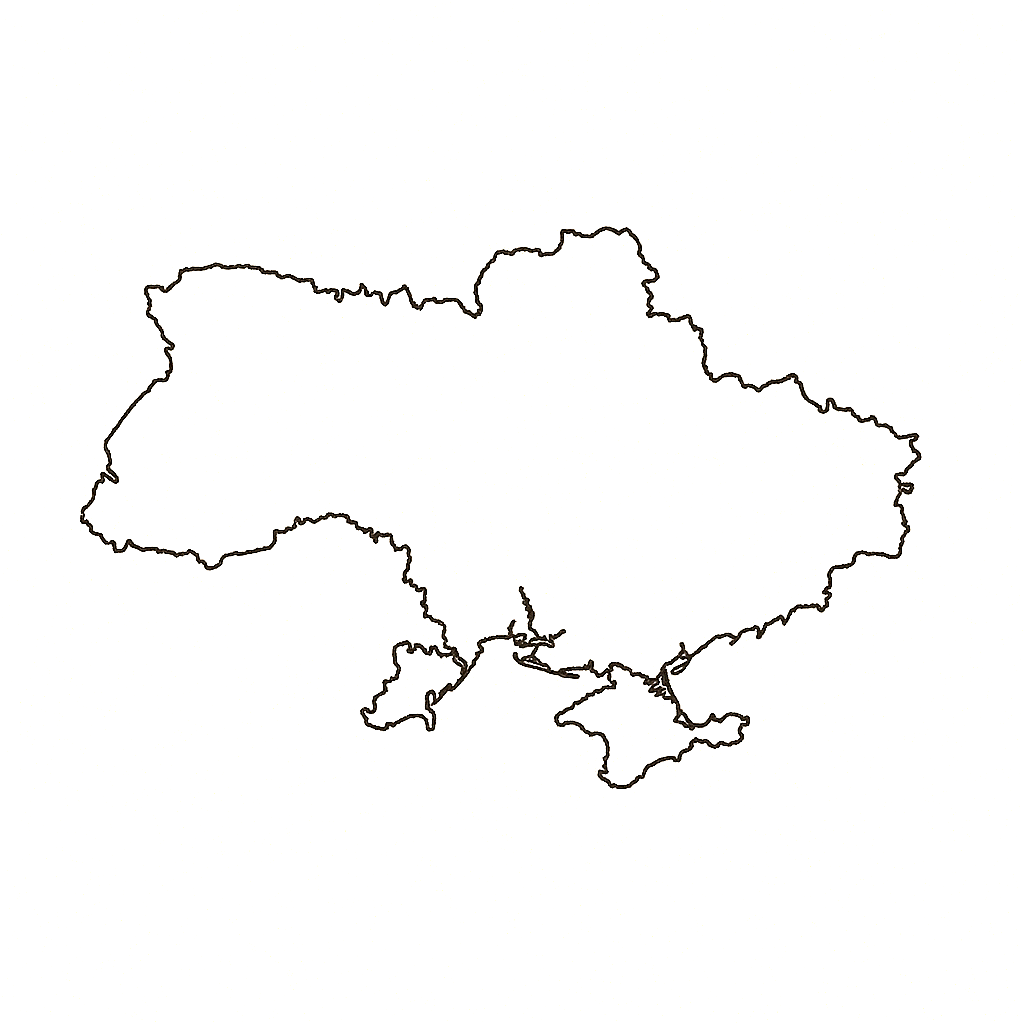
A large European country on the Black Sea, with Kyiv (Kiev) as its capital.
It covers an area of about 603,700 km² — roughly 19.7 times the size of Belgium.
Its population is currently around 36–38 million within the country, significantly reduced due to war and refugee flows compared to the pre-2022 level of ~41–44 million.
Ukraine is not a classic colony, but it was historically ruled by Poland–Lithuania, Russia, the Habsburgs, and later the USSR.
It became independent on 24 August 1991 (confirmed by a referendum on 1 December 1991).
This land was not a classic colony in the way African or Asian territories were. Over the centuries, the region was divided and governed by larger empires:
Christianisation of Kievan Rus’ took place in 988, when Grand Prince Volodymyr/Vladimir was baptised. Byzantine (Eastern Orthodox) clergy introduced liturgy, schools, and monastic life. Early centres included the Kyiv Pechersk Lavra (Cave Monastery, 11th century), Chernihiv, and Volodymyr-Volynskyi.
Latin Catholic presence (Middle Ages–Early Modern period) came through Dominicans and Franciscans in the urban centres of Galicia and Volhynia (Lviv, Kamianets-Podilskyi). The Jesuits (from the 16th–17th centuries) were also active in the Polish-Lithuanian areas, founding colleges in Lviv, Ostroh, and elsewhere.
The Eastern Catholic tradition (Ukrainian Greek Catholic Church) emerged through the Union of Brest (1596), when part of the Orthodox Church recognised the Pope while keeping the Byzantine rite. The Basilian Order became influential in education and mission work, especially in the west.
Why was there mission?
Evangelisation of the Slavs (Byzantine influence via Constantinople) and, later, confessional competition and reform movements in the borderlands between Orthodoxy and Catholicism.
There was considerable poverty early on due to serfdom, border wars, and famine, leading to widespread rural poverty.
From 1932–33, the Holodomor (a man-made famine) claimed millions of lives.
During the post-Soviet 1990s, the country went through a deep recession and a severe spike in poverty.
Since 2014 (war) and especially 2022 (full-scale invasion), Ukraine has faced intense economic and humanitarian pressure; regional differences are large (east/south vs. west/centre).
Persistent difficulties for missionary work centred on confessional tensions:
Orthodox (under different jurisdictions) vs. Greek-Catholic vs. Latin Catholic/Protestant.
There were also pressures from imperial and state authorities: Tsarist and Soviet repression, confiscations, and censorship.
War and displacement caused destruction of infrastructure, migration, and trauma.
Language and culture also posed challenges: long-standing multilingualism (Ukrainian, Russian, mixed varieties, and minority languages).
The earliest mission centres were Eastern Orthodox: Kyiv (Pechersk), Chernihiv, Pereiaslav, Halych.
But there were also early Latin and Jesuit mission posts: Lviv, Kamianets-Podilskyi, Ostroh, and other urban centres. (More coastal and port-based missions in the south developed only later, after Russian expansion toward the Black Sea.)
CICM (Scheut) never had its own mission or province in Ukraine.
Catholic work in Ukraine was carried primarily by the Ukrainian Greek Catholic Church (Basilians, etc.) and by orders such as the Jesuits, Redemptorists, Salesians, Dominicans, Franciscans, and various congregations active in Caritas and parish ministry.
 Missionaries of Zutendaalse side by side...
 On the world map...