
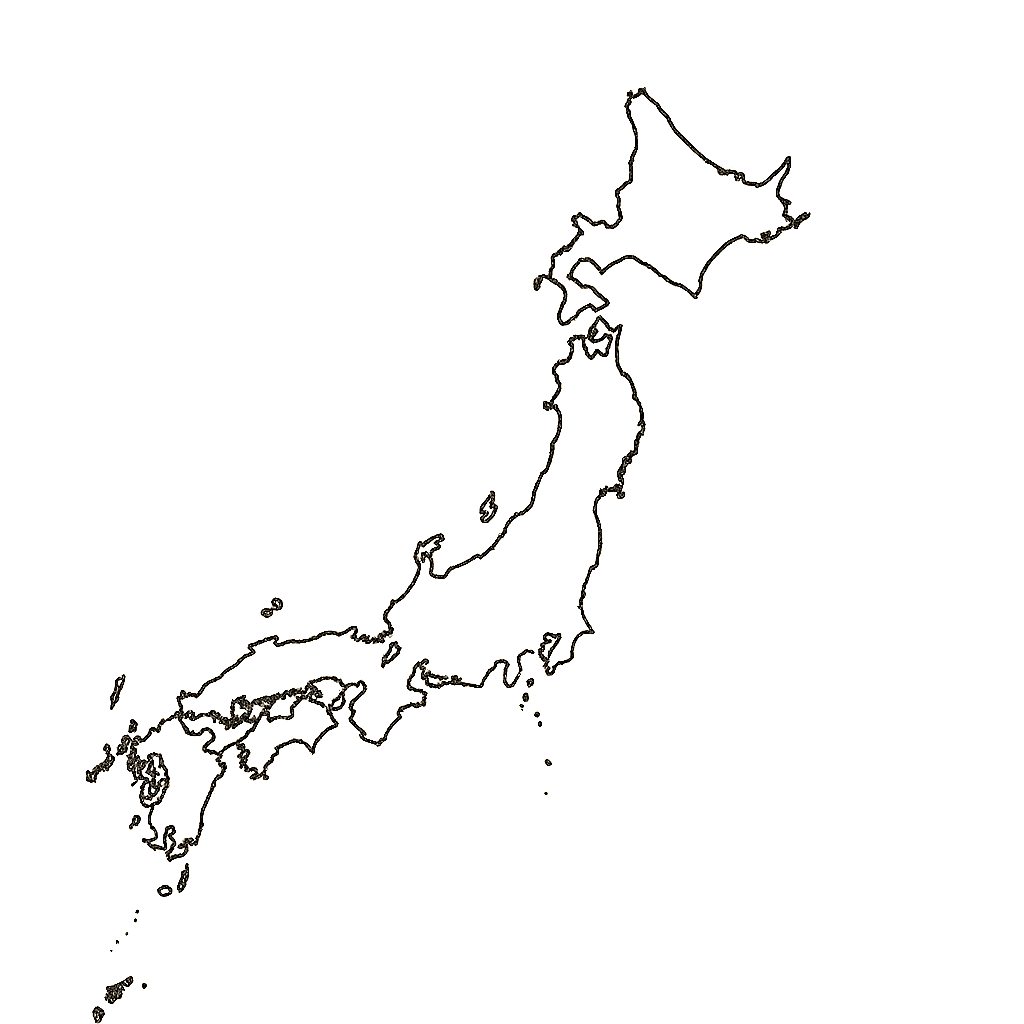
Island nation in East Asia (Hokkaido, Honshu, Shikoku, Kyushu + surrounding islands).
Capital: Tokyo.
Area of Japan: ~377,975 km² — about 12.3 times the size of Belgium (Belgium: 30,689 km²).
Population of Japan (2025): ~123–124 million (Belgium: ~11.8 million).
Colony? No. However, Japan was under Allied (U.S.) occupation from 1945 to 1952, and regained full sovereignty in 1952.
Around 1600 (start of the Tokugawa era), Japan had approximately 12–18 million inhabitants.
At the first modern census in 1872, the population was about 33 million;
by 1935, nearly 70 million;
and by 2025, around 125 million, with a slight decline due to ageing and low fertility.
Japan itself was never colonised, but it did experience a U.S. occupation from 1945 to 1952 (after World War II). Sovereignty was restored by the San Francisco Peace Treaty (1952). Historically, Japan was rather a colonising power (Taiwan 1895–1945, Korea 1910–1945, parts of Manchuria/China).
The first missionaries arrived in 1549, when Francis Xavier (a Jesuit) landed in Kagoshima (Kyushu). He was on a global Catholic mission and gained access through Portuguese trade (the Nanban trade).
Early centres of mission activity included Kagoshima, Hirado, Yamaguchi, and Kyoto; later Nagasaki became the Catholic city (founded in 1571 with Jesuit support). Other orders joined: Franciscans (from the 1580s) and later Dominicans, with rivalry but also cooperation.
Mission work in Japan grew rapidly at first, but soon faced prohibition and persecution.
The first mission stations were initially located along the coast and in trading cities during the 16th century (Catholic missions), mainly in the south and west: Kagoshima, Hirado, Yamaguchi, Nagasaki, Kyoto.
In the 19th century (mission restart), work re-emerged in treaty and consular port cities: Yokohama, Nagasaki, Kobe, and later Tokyo, Osaka, and university centres.
Key objectives of the missionary work included inculturation and education (the Jesuit approach; later also Protestants with schools and universities), with strong attention to care and charity (hospitals, orphan care). Missionaries also invested heavily in Bible translation, printing houses, and dialogue with Shinto and Buddhism. Christian witness under persecution (martyrs) and the rediscovery of the hidden Christians were central themes.
For centuries, Japan maintained a persistent state policy of prohibition and persecution (16th–19th centuries). Religious and cultural structures shaped this environment: Shinto rituals, Buddhist temple registers (the danka system), and ancestor veneration. The Meiji nationalism and later wartime mobilisation added pressure against foreign influence.
Language and script (kanji/kana) posed a high barrier for missionary literature.
There was no real CICM mission in Japan. CICM (founded in 1862 “for China”) worked primarily in China/Mongolia (from 1865), Congo (1888), the Philippines (1907), Brazil (1952), Taiwan (1955), the United States, etc.
In Japan, CICM never established a lasting province or mission territory comparable to these regions. Catholic work in Japan was carried mainly by the Jesuits, MEP, Franciscans, Dominicans, Salesians, Maryknoll, and others.
Until 1868, Japan was a feudal society. After that came Meiji modernisation and rapid industrialisation.
After World War II, Japan was an occupied country undergoing reconstruction; in the 1950s it was still a recipient country, but from the 1960s–70s onward it entered the golden years of the economic miracle—becoming a high-income country and even a donor nation (including ODA).
For the Church, Japan remained a small but stable minority context, with a strong emphasis on education, care, and dialogue.
For missionary organisations, Japan was a country with a small Christian minority (˜1–2%), but economically strong. It functioned more as a place of presence, education, and dialogue than as a large-scale “development field.”
Japan does provide some financial support (e.g., Caritas Japan), but for CICM, fundraising was primarily based in Belgium/Europe and the United States, not in Japan.
 Missionaries of Zutendaalse side by side...
 On the world map...